Lesson 9
Operations Subsystem
Structure
- Concept of operations
- Objective of the operations subsystem
- Decision making
- Strategic decisions
- Operational decisions
1. Concept of operations
In a purely manufacturing context they used words such as production and production function
Because they produced material goods, products
But as economy evolves services and intangibles become more important
So the terminology changes from production system (subsystem) to operations subsystem
Production function:
To buy raw materials
To store materials
To manufacture
To determine location of premises
To determine production capacity
To determine how to produce
…
2. Objective of the operations subsystem
Main goal: to improve efficiency
Secondary goals:
To reduce costs
To meet delivery time
To improve quality
To increase flexibility
To improve customer service
Efficiency
Technical efficiency: physical units < 1
Economic efficiency: monetary units > 1
Technical Efficiency=Computers+Monitors+Printers+CellphonesWorking hours+electricity kw+processors+...(1)
Economic Efficiency=pcomputers⋅Computers+pmonitors⋅Monitors+pprinters⋅Printers+pcell⋅Cellphonespw⋅Working hours+pe⋅electricitykw+pp⋅processors+...(2)
Cost reduction
To increase results (profits, EBIT, …)
Profits=0
Revenue = Expenses
p⋅x=F+v⋅x
x=Fp−v
Break-even point
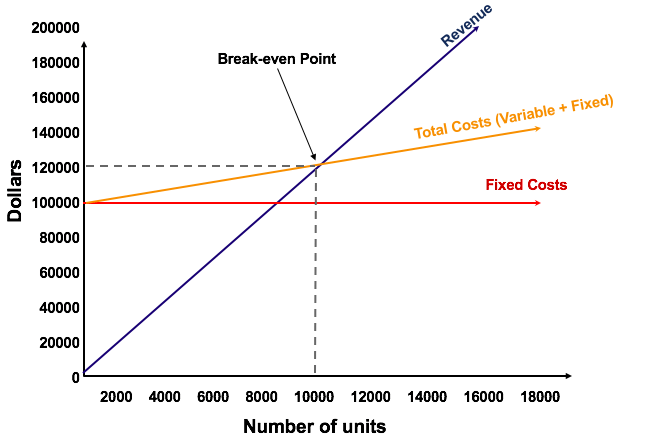
Cost Volume Profit plot
3. Decision making
Strategic decisions
Operational (tactical) decisions
Decision classification
STRATEGIC DECISIONS (long term)
Product selection and design
Process selection and design
Work design
Capacity
Location
Plant layout
OPERATIONAL DECISIONS
Production planning
Production programming
Execution and control
Inventory management
4. Strategic decisions
Decisions to help achieve company’s goals
Product selection and design
Process selection and design
Work design
Capacity
Location
Plant layout
Product selection and design
Global and key decision:
Type of product
Product characteristics
Goal market
Production volume
…
Decision comes from customer need and R+D+I activities
Idea –> Assessment (technical, commercial and financial viability)
Product selection and design II
Determines the company’s competitiveness
Competitiveness: competence of an organization or country to produce and sell products/services that meet the quality of the markets at the same or lower prices and maximize returns on the resources consumed in producing them.
Ability of organizations to produce goods or services with a favorable quality-price ratio that guarantees good profitability while achieving customer preference over other competitors. Competitiveness ensures that the company is sustainable and durable.
Product selection and design III
It determines cost, quality, delivery time
Bad designs can cause economic losses
It determines the production process
Many manufacturing problems are caused by the product design
It allows differentiating from competitors
Product selection and design IV
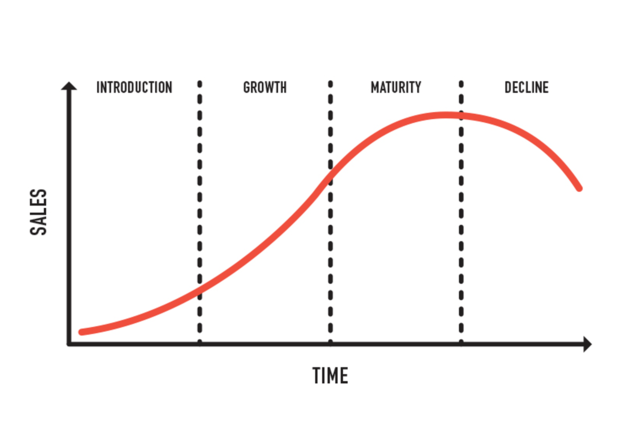
Product life cycle: Evolution pattern of sales
Each stage may need different strategies and decisions
Process selection and design V
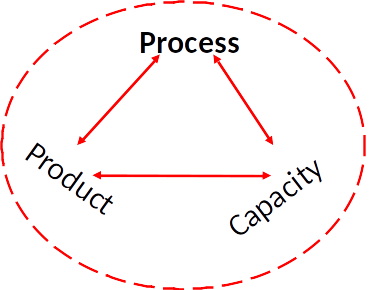
How to develop production activities
Technology
Resources
Process definition is linked with the product and with the production capacity
Work design
To define:
Positions needed in the production process
Tasks to carry out in each position
To take into account:
Specialisation
more efficiency
more burn-out
Technology
Production Capacity
Long-term capacity
- quantity of products or services that can be produced for a given period under normal conditions
Production volume: actual quantity of products produce by a production unit for a given period
Usually capacity > volume
Sometimes capacity < volume
- extraordinary conditions, double-shift, extratime, …
Production Capacity II
- Long-term capacity depends on the fixed structure of the company
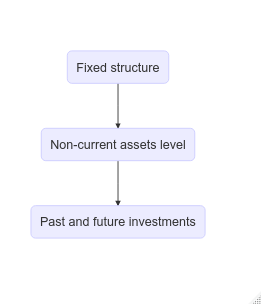
To change capacity is strategic decision
It implies big investments
Hard to go back
Production Capacity III
Capacity affects the competitiveness of the company:
Low capacity: bad service, diminishing market share
Excessive capacity: idle resources, low returns, lower prices to increase demand, increasing inventory
Which is the right point? Production optimum
Production Capacity IV
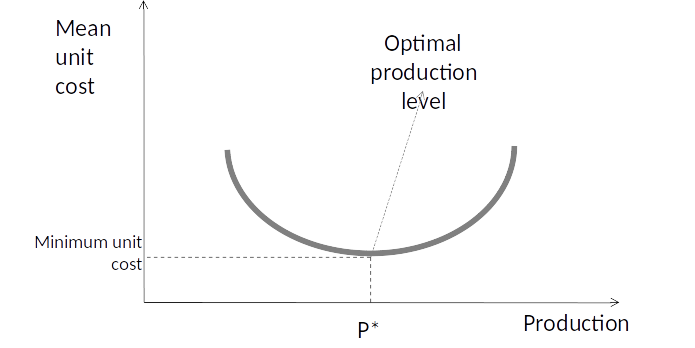
Production volume < P*
Resource underutilization: more operation expenses
Fixed costs split up among a lower number of produced units
Production volume > P*
More operation costs
Extratime, premises overutilisation
In the long-term need to expand
Location
- Where to place production plant, headquarters,…
Factors to consider:
Raw materials sources
Markets
Transport means
Transport costs
Labour availability
Climate conditions
Laws
Fiscal pressure
Land availability
Currency
Political stability
Plant layout
Physical arrangement of industrial facilities i.e arrangement of machines, processing equipment and service departments to achieve greatest co-ordination and efficiency of peopla, materials, machines and methods in a plant
Factors:
Available area
Machinery type
Work conditions
Type of product and process
Everything about an aircraft manufacturing and assembly building must be driven by the manufacturing process link
5. Operational decisions
Decisions that are adjusted more frequently in correspondence to the current external and internal conditions, which usually have impacts for no longer than a year or even a day
Operational managers and other staff members make operational decisions. An operational decision influences day-to-day activities and only has a short-term impact on a business. These include scheduling employees or equipment use, what products to purchase from suppliers, determining how much inventory to keep, etc.
Production planning
Production programming
Execution and control
Inventory management
Production planning
Decisions on:
quantity of products and type
resources to use
capacity adjustments
Time horizon: from 6 months to 3 years
A production planning needs:
Bill of materials (BOM) link
Stock level (inventory)
Cost of resources
Lot sizes
Manufacturing lead time
Job position add (entry level) link
Production scheduling
More detailed than production planning
It deals with:
- Identifying and assigning the appropriate number of workers
- Identifying and allocating the appropriate raw materials
- Identifying and assigning appropriate machinery and equipment
- Synchronizing all the resources to define priorities and fulfill customer needs
Execution and control
Decisions on workloads for every section
To adjust production when there is any production incident (stock breaking, strikes, machinery failures, process delays, etc)
Control or monitoring to check deviations from plans and adjustments results
Inventory management
In the storehouse till needed
Raw materials, materials, spare parts, WIP, finished products
They need space
They have economic value
Inventory is not one of the company goals
To manage inventories imply costs
They are an asset –> they diminished return on assets why?
ERP
Enterprise Resource Planning
Software system
It helps company run their entire business
Automation and processes in finance, human resources, manufacturing, supply chain, services, etc
📝Exercise 9.1
The following data come from the income statement of Ryan Air for 2020.
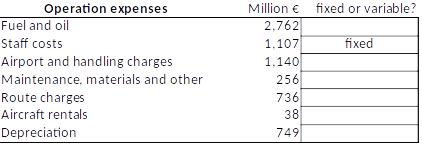
- Fill in the table, stating if each cost is fixed or variable.
2. If the number of passengers was 149 million, work out the minimum average rate to obtain profits
3. If the revenue was 8,494 million Euros, draw the break-even plot (Euros in Y axis, passengers in the X axis). Indicate the value of the main points
